

 By
By Property Owner Compliance Dubai: 10 Essential Legal Checks
Property owner compliance Dubai requirements can affect ownership records, rental income, service charges, property management and future transactions. Whether you are a landlord, end-user, overseas investor or long-term property owner, keeping your documents and obligations in order can help reduce avoidable disputes and protect the value of your property.
Property owner compliance Dubai is not limited to holding a valid title deed. Depending on the property and how it is used, owners may need to monitor tenancy registration, rental rules, service charges, maintenance responsibilities, broker licensing, mortgages, official notices and other regulatory requirements.
This practical checklist explains the main compliance areas Dubai property owners should review and when professional legal assistance may be appropriate.
For property-related legal assistance, you can also review our real estate legal services in Dubai.
Table of Contents
What Does Property Owner Compliance in Dubai Include?
Property owner compliance Dubai generally involves keeping ownership information accurate, following applicable tenancy requirements, meeting financial and maintenance obligations and responding appropriately to regulatory or contractual matters.
The specific obligations can differ depending on whether the property is:
- Owner-occupied
- Rented to a tenant
- Part of a jointly owned development
- Mortgaged
- Commercial
- Residential
- Held by an individual or company
The Dubai Land Department provides official real estate services and information, including title-deed services, rental services, service-charge information and licensed real estate professional verification.
Property Owner Compliance Dubai: 10 Essential Checks
1. Keep the Title Deed and Ownership Records Accurate
A property owner should verify that the ownership information recorded with the Dubai Land Department remains accurate.
Review:
- Owner name
- Property and unit details
- Ownership information
- Title deed information
- Property measurements where relevant
- Mortgage or financing information
- Changes following transfer or other legal transactions
DLD provides an official title deed service for title-deed issuance and related updates.
If ownership information changes because of a sale, inheritance, corporate restructuring or another legally relevant event, the appropriate records should be updated.
Potential risk if ignored: Problems during a sale, mortgage, transfer or ownership-related dispute.
2. Register Rental Contracts Through Ejari
If you rent out your property, check the applicable requirements for registering the tenancy contract through Ejari.
Property owners should ensure that important tenancy information is accurate, including:
- Landlord details
- Tenant details
- Property information
- Contract period
- Rent
- Payment arrangements
- Other material contractual terms
Owners should also retain copies of the signed tenancy agreement, registration records, payment evidence and relevant correspondence.
Proper tenancy documentation is an important part of property owner compliance Dubai, particularly when a landlord later needs to establish the contractual relationship or enforce a legitimate right.
3. Check Applicable Rental Increase Rules
Landlords should not assume that they can increase rent by any amount at renewal.
The Dubai Land Department’s official Rental Index provides a service for calculating rental increases and average rental values based on the relevant property and tenancy information.
Before proposing a rental increase, check:
- Existing rent
- Contract expiry date
- Property type
- Area
- Applicable rental information
- Required notice
- Relevant tenancy legislation
- Any contractual provisions affecting the renewal
Keeping evidence of the calculation and notices can also be useful if the tenant later challenges the increase.
4. Follow the Correct Eviction and Notice Procedure
Eviction is an area where property owners should obtain legal advice before taking action.
Dubai Law No. 26 of 2007, as amended by Law No. 33 of 2008, identifies circumstances in which a landlord may seek eviction and establishes specific requirements for certain expiry-of-lease eviction grounds. For specified grounds such as demolition, comprehensive renovation, personal use or sale, the amended law requires at least 12 months’ notice through a Notary Public or registered mail.
This means property owners should not rely on a generic statement that every eviction requires exactly 12 months’ notice.
Before serving notice, check:
- The reason for eviction
- Whether the legal ground applies
- The timing of the notice
- The required method of service
- The tenancy contract
- The applicable legislation
- Whether supporting documents are required
Incorrect notice procedures can create unnecessary disputes and delays.
5. Monitor Service Charge Obligations
Owners of units in jointly owned developments should monitor applicable service charges and payment records.
Dubai Land Department provides an official Service Charge Index for approved service fees for jointly owned properties.
DLD also explains that common service charges are approved through the applicable RERA framework and can be checked through the Service Charge Index.
Owners should:
- Review service-charge statements
- Check approved charges
- Keep payment records
- Monitor outstanding balances
- Review relevant budgets
- Raise genuine discrepancies through the appropriate process
Do not simply stop paying an amount because you believe a service charge is incorrect. Obtain appropriate advice about the available challenge or dispute process.
6. Understand Owners’ Association and Joint-Property Responsibilities
If your property forms part of a jointly owned development, additional management and financial considerations may apply.
Owners should stay informed about:
- Building management
- Common-area maintenance
- Approved service charges
- Budgets
- Building notices
- Community rules
- Meetings and owner communications
- Maintenance and repair issues
Active participation can help an owner understand how common-property decisions may affect ongoing costs and the property itself.
Property owner compliance Dubai therefore includes more than obligations owed to government authorities; contractual and jointly owned property responsibilities can also be important.
7. Maintain the Property and Address Safety Issues
Owners should understand their maintenance responsibilities under the applicable lease, property arrangements and law.
For rented property, review which obligations belong to the landlord and which belong to the tenant.
Important areas may include:
- Structural issues
- Major repairs
- Building systems
- Water leaks
- Electrical problems
- Air-conditioning systems
- Safety issues
- Common-area problems
- Damage caused by occupants
Dubai tenancy legislation also addresses maintenance and restoration responsibilities between landlords and tenants.
Keep records of:
- Maintenance requests
- Contractor invoices
- Inspection reports
- Repair photographs
- Communications with tenants
- Completion records
Good documentation can become valuable evidence if a maintenance dispute later develops.
8. Keep Mortgage, Lien and Financing Records Updated
If a property is financed, owners should maintain accurate records relating to:
- Mortgage registration
- Outstanding financing
- Bank correspondence
- Repayment
- Release of security
- Title-deed information
After repayment, confirm that the relevant release or cancellation procedures have been completed where applicable.
This is particularly important before attempting to sell, transfer or refinance the property.
A property owner should not assume that repaying a loan automatically means every related registration has already been updated.
9. Use Properly Licensed Real Estate Professionals
Owners who use brokers or real estate agencies should verify that the relevant professional is properly licensed.
Dubai Land Department provides services for checking licensed real estate brokers and brokerage offices.
Before appointing an agent, consider confirming:
- Broker licensing
- Brokerage company details
- Authority to market the property
- Commission arrangements
- Scope of the broker’s authority
- Marketing permissions
- Documentation requirements
Property owner compliance Dubai can be undermined when owners assume that an agent automatically handles every legal and regulatory obligation.
The owner remains responsible for understanding the legal effect of documents and arrangements entered into on the owner’s behalf.
10. Monitor Regulatory Changes and Keep Records
Dubai’s property market is regulated through legislation, government services, regulatory procedures and contractual requirements.
Owners should maintain an organised record of:
- Title documents
- Sale and purchase agreements
- Tenancy contracts
- Ejari records
- Rent payments
- Service charges
- Mortgage documents
- Maintenance records
- Broker agreements
- Official notices
- Government correspondence
- Settlement agreements
- Legal advice where relevant
Regular record-keeping is one of the simplest ways to improve property owner compliance Dubai.
If an official notice is received, do not ignore it. Determine what it concerns, whether a deadline applies and whether professional assistance is required.
Common Property Compliance Mistakes in Dubai
Some recurring problems arise because owners assume that a previous arrangement remains valid indefinitely.
Common mistakes include:
- Failing to maintain accurate ownership records
- Not registering or updating tenancy documentation
- Applying rent increases without checking applicable rules
- Using the wrong eviction notice procedure
- Ignoring service-charge statements
- Delaying important maintenance
- Using an unverified broker
- Failing to update mortgage-related records
- Losing copies of important contracts
- Ignoring official correspondence
- Relying on verbal agreements
A compliance problem does not necessarily arise because an owner deliberately ignored the law. Missing a deadline, misunderstanding a contractual obligation or relying on outdated information can also create legal exposure.
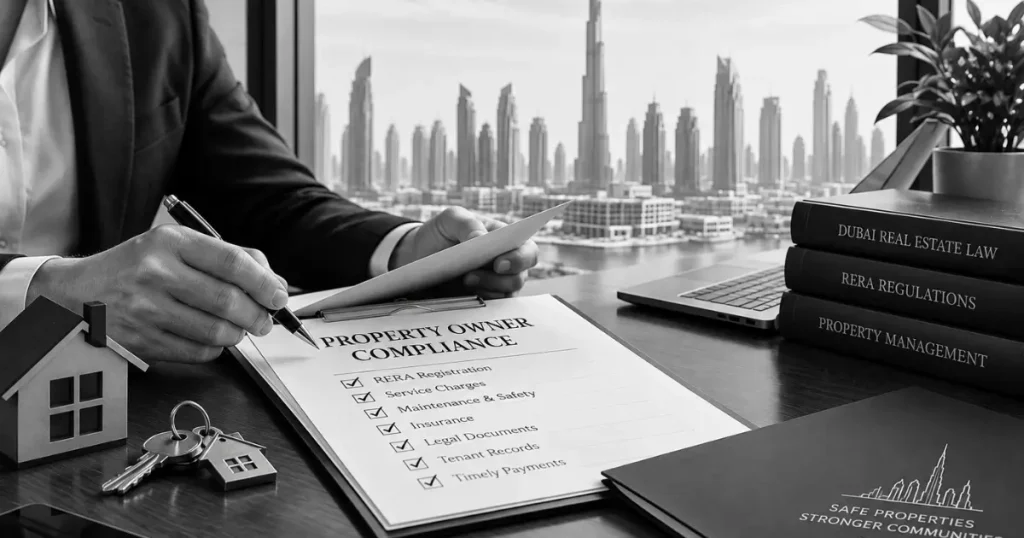
Property Owner Compliance Dubai Checklist
Use this quick review periodically:
| Compliance Area | What to Check |
|---|---|
| Title deed | Are ownership details accurate? |
| Rental property | Is the tenancy documentation properly registered? |
| Rent | Has any increase been checked against applicable rules? |
| Eviction | Is the correct legal ground and notice procedure being used? |
| Service charges | Are approved charges and payments up to date? |
| Joint property | Are building and owner communications being monitored? |
| Maintenance | Are significant repairs being addressed and documented? |
| Mortgage | Have financing records and releases been updated? |
| Broker | Is the broker properly licensed? |
| Records | Are contracts, notices and payment evidence retained? |
Why Legal Guidance Can Help Property Owners
Property owner compliance Dubai can become complicated when several obligations overlap.
A property lawyer may assist with:
- Reviewing tenancy contracts
- Checking rental disputes
- Assessing eviction notices
- Reviewing service-charge disputes
- Examining ownership documents
- Advising on property transactions
- Reviewing broker agreements
- Handling contractual disputes
- Preparing legal notices
- Representing owners in applicable proceedings
Legal advice is particularly useful when a compliance issue has already developed into a dispute or when a property transaction involves substantial financial exposure.
For disputes involving landlords, tenants or property contracts, you can also read our guide to property disputes in Dubai.
Frequently Asked Questions About Property Owner Compliance in Dubai
What are the main compliance responsibilities of a Dubai property owner?
The applicable responsibilities depend on the property and its use, but commonly include maintaining accurate ownership records, following tenancy requirements, complying with applicable rental rules, paying approved service charges, maintaining the property and responding to official notices.
Is Ejari important for property owners?
For rented properties, owners should follow the applicable requirements for tenancy registration through Ejari and keep accurate contractual and registration records.
Can a Dubai landlord increase rent whenever they want?
No. Applicable rental rules and the relevant tenancy circumstances should be considered. The Dubai Land Department provides an official Rental Index that can be used to assess rental information and potential increases.
Does every eviction require 12 months’ notice?
No. The 12-month notice requirement applies to specified grounds for eviction at the expiry of the lease under the amended Dubai tenancy legislation. Other eviction circumstances have different requirements.
How can I check service charges for my property?
Dubai Land Department provides a Service Charge Index for approved service fees relating to jointly owned properties.
Should property owners use licensed brokers?
Owners should verify the relevant broker or brokerage office through the available Dubai Land Department licensing and verification services before entering into arrangements.
When should a property owner consult a lawyer?
Legal advice can be particularly useful when dealing with eviction, rent disputes, service-charge disagreements, ownership problems, complex tenancy contracts, mortgage issues, property transfers or threatened litigation.
Final Thoughts: Compliance Helps Protect Your Property
Property owner compliance Dubai should be treated as an ongoing responsibility rather than a one-time exercise.
Owners should keep their title and transaction records accurate, follow applicable tenancy requirements, monitor rental rules and service charges, maintain the property, verify brokers and respond properly to official notices.
The most important point is to check the rule that actually applies to the specific property and situation rather than relying on general assumptions.
Regular compliance reviews can help identify problems before they become expensive disputes.
For professional assistance with property compliance, tenancy matters or real estate disputes, visit our real estate legal services in Dubai.
Important Note
This article provides general information about property owner compliance in Dubai and is not legal advice for a specific property or dispute. Requirements can vary according to the property, tenancy arrangement, ownership structure, contractual documents and applicable legislation. Property owners should obtain professional legal advice where a significant compliance issue, dispute, transaction or notice is involved.