


 By
Legal Risks in Standard Property Contracts in Dubai: 15 Critical Warnings
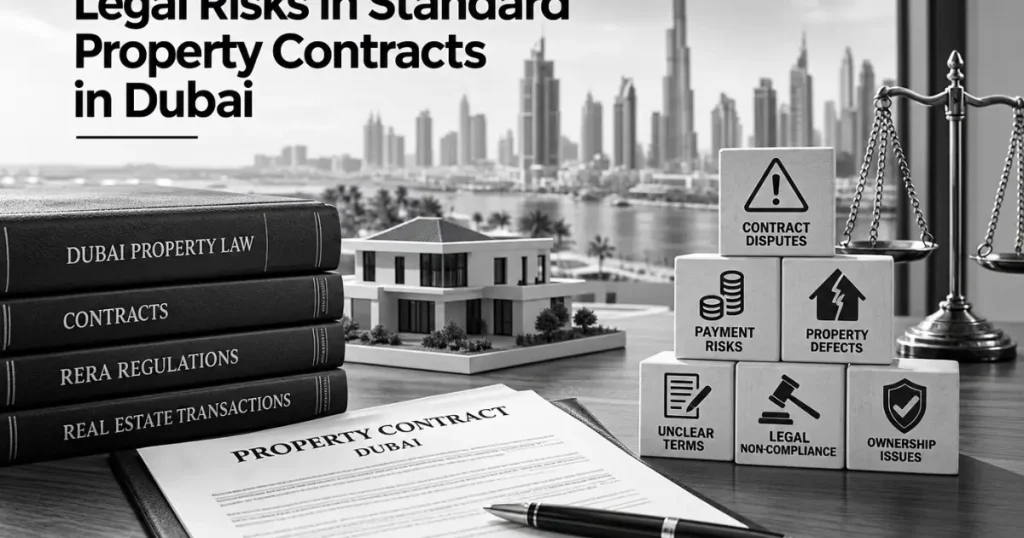
Buying or selling property in Dubai often involves standard-form agreements prepared by developers, sellers, agents or property management companies. Although these contracts can make transactions faster, signing a standard document without understanding its legal and financial consequences can create significant problems later.
The most important legal risks in standard property contracts in Dubai are often hidden in clauses dealing with payment deadlines, completion dates, default, termination, refunds, penalties, liability, maintenance, dispute resolution and changes to the property or development.
A contract may look straightforward while allocating substantially different obligations to the buyer and seller. This is particularly important for off-plan transactions, where payment schedules, construction milestones, escrow arrangements and completion obligations can have a major financial impact.
A careful contract review should therefore identify the legal risks in standard property contracts in Dubai before the buyer makes an irreversible commitment.
Before signing, buyers should review the complete agreement rather than relying only on the commercial terms discussed by a broker or sales representative. For broader guidance, you can also review our property lawyer in Dubai resource for information about legal support during property transactions.
Table of Contents
What Are the Legal Risks in Standard Property Contracts in Dubai?
The legal risks in standard property contracts in Dubai arise when contractual wording creates obligations, limitations or financial consequences that a party does not fully understand before signing.
Under the UAE Civil Transactions Law, a contract generally creates binding obligations between the contracting parties, subject to the applicable law and circumstances. The current UAE legislation should therefore be considered alongside any special rules that apply to the particular property transaction. The official UAE legislation platform provides the current federal legislative framework. Read the current Civil Transactions Law.
In practice, the risk is not necessarily that a standard contract is automatically invalid. The greater concern is that a buyer or seller may agree to commercially significant terms without appreciating how those terms operate if the transaction encounters delays, default, financing problems or a dispute.
15 Legal Risks in Standard Property Contracts in Dubai Buyers Should Check
1. Unclear Payment Deadlines
Payment schedules are among the most important provisions in a property contract. A missed instalment may trigger interest, administrative charges, default provisions, suspension of contractual rights or other consequences depending on the agreement and applicable law.
Buyers should check every payment date, amount, payment method and condition attached to each instalment. The contract should also be reviewed against the commercial payment plan supplied during the transaction.
One of the common legal risks in standard property contracts in Dubai is assuming that an informal extension agreed by a salesperson automatically changes the written contractual deadline. Important amendments should be documented appropriately.
2. Developer or Seller Delay
Completion provisions deserve careful attention, particularly in off-plan transactions. A contract may provide estimated or contractual completion dates and may also contain mechanisms dealing with permitted extensions.
Buyers should determine what happens if completion is delayed, whether notice must be provided, what contractual remedies may be available and whether particular events extend the contractual period.
Do not assume that every delay automatically gives the buyer an immediate right to cancel the agreement. The actual contract wording, applicable regulations and circumstances need to be examined.
3. Broad Force Majeure Clauses
Force majeure provisions can significantly affect contractual obligations when circumstances outside a party’s control interfere with performance.
The important questions include what events qualify, how long the event must continue, whether notice is required, whether payment obligations continue and what happens if the disruption becomes prolonged.
A broadly drafted clause can create uncertainty if its wording is not carefully understood before signing. This is one reason buyers should identify legal risks in standard property contracts in Dubai before relying on a standard developer template.
4. Termination Rights That Are Not Balanced
Termination clauses deserve particular scrutiny. A contract may specify circumstances in which one party can terminate, while imposing different procedural or financial requirements on the other party.
Review whether termination requires written notice, a cure period, a specific default, regulatory approval, court involvement or another procedure.
For a deeper explanation of this issue, see our guide to contract termination clauses in Dubai property contracts.
5. Refund and Cancellation Provisions
Cancellation does not necessarily mean that all amounts paid will immediately be returned. The contract may contain provisions concerning deductions, outstanding obligations, administrative costs or other consequences, subject to applicable law.
Buyers should identify exactly when a refund becomes due, how the amount is calculated and whether any contractual procedure must be completed first.
For off-plan projects, the regulatory framework can also matter. Dubai Land Department states that escrow accounts are used for amounts collected from purchasers of off-plan units and are intended to regulate the construction process and protect investors’ rights. See Dubai Land Department’s official escrow FAQ.
6. Escrow and Payment-Protection Assumptions
Another important issue is assuming that every property payment has identical regulatory protection. Buyers should establish whether the transaction is an off-plan sale, whether the relevant project is registered and how payments are supposed to be made.
Dubai Land Department’s project-registration service specifically provides for registration of a real estate development project and opening of an escrow account for off-plan sales. Check the official DLD project-registration service.
The presence of an escrow framework does not mean that a buyer should ignore the contract. Payment instructions, project status, registration information and contractual rights should all be checked.
7. One-Sided Default Clauses
Default provisions can create substantial financial exposure. A contract should be examined to determine what constitutes default, whether notice is required, how much time is available to remedy the breach and what consequences follow.
Look for provisions dealing with late payments, failure to complete documentation, failure to take possession, financing issues and other potential breaches.
These provisions are particularly important because legal risks in standard property contracts in Dubai often become apparent only after a party has already missed a contractual obligation.
8. Penalties and Administrative Charges
Standard contracts may contain various charges connected with late payments, amendments, cancellation, transfer, documentation or other administrative matters.
Buyers should not assume that a charge mentioned in a sales conversation is the complete financial exposure. Review the agreement, schedules, annexures and referenced policies together.
If a charge appears unclear or disproportionate, obtain transaction-specific legal advice before signing rather than waiting until a dispute arises.
9. Changes to Property Specifications
Off-plan agreements may contain provisions addressing changes to layouts, materials, finishes, facilities or specifications. The legal and commercial effect depends on the wording and the applicable regulatory framework.
A buyer should understand which changes may be permitted, whether equivalent alternatives can be substituted and what rights arise if the completed property materially differs from what was contracted.
These are significant legal risks in standard property contracts in Dubai because brochures, advertisements and verbal representations may not contain the same level of contractual detail as the signed agreement.
10. Handover and Inspection Requirements
Handover clauses can determine when the buyer must inspect the property, report defects, complete documentation and take possession.
Check whether the contract specifies an inspection process, notice period, snagging procedure and consequences of failing to attend or respond within a particular period.
Keep written records of inspections, notices, photographs, correspondence and defect reports. Proper documentation can become important if a disagreement later develops.
11. Service Charges and Other Property Costs
Property contracts may refer to service charges, maintenance costs, registration expenses, utility-related payments, community charges and other transaction expenses.
The contract should clearly identify which party is responsible for each cost and when the obligation begins.
Buyers should also distinguish between the purchase price and recurring ownership costs. A property that appears commercially attractive may involve additional contractual or ownership expenses that should be understood before completion.
12. Liability and Indemnity Clauses
Indemnity provisions can create obligations that extend beyond the immediate transaction. They may require one party to compensate another for specified losses, claims, liabilities or expenses.
Do not treat an indemnity clause as standard wording that can automatically be ignored. Its scope, trigger events, exclusions and duration should be considered carefully.
Where a contract contains unusually broad liability language, legal review can help identify the practical exposure before the agreement becomes binding.
13. Dispute Resolution and Jurisdiction
A property contract should explain how disputes are to be handled. Depending on the transaction, the agreement may contain provisions concerning negotiation, mediation, arbitration or court proceedings.
The applicable dispute-resolution mechanism can affect the procedure, costs, evidence and timeline involved in resolving a disagreement.
For a broader overview, see our guide to property disputes in Dubai and our article on mediation in property disputes in Dubai.
14. Entire Agreement and Verbal-Promise Problems
Property transactions frequently involve discussions between buyers, sellers, brokers and sales representatives before the final agreement is signed.
A buyer should not assume that every verbal promise becomes a contractual obligation. If an important representation influenced the decision to purchase, it should be documented appropriately and, where relevant, reflected in the contractual documents.
Important matters can include promised facilities, completion dates, payment concessions, parking spaces, layouts, upgrades, maintenance commitments and other commercial representations.
This is one of the most preventable legal risks in standard property contracts in Dubai: relying on statements that are not clearly reflected in the final contractual documentation.
15. Missing or Inconsistent Annexures
Property agreements frequently refer to schedules, specifications, payment plans, floor plans, disclosure documents, community rules or other annexures.
Before signing, confirm that every referenced document is available and that the documents do not contradict each other.
If the main agreement says one thing while an annexure or payment schedule says something different, the contractual interpretation can become more complicated. A lawyer should review the documents together rather than reviewing only the signature page or main contract.
How to Review a Standard Property Contract Before Signing
A practical review should go beyond checking the purchase price. The following process can help identify legal risks in standard property contracts in Dubai before they become expensive disputes.
- Confirm the parties: Check the legal names and authority of the buyer, seller, developer or other contracting parties.
- Verify the property: Confirm the unit number, project, location, specifications and relevant registration information.
- Check the price: Match the contract price against the agreed commercial terms.
- Review payment dates: Check every instalment and the consequences of late payment.
- Read default provisions: Identify what constitutes a breach and what remedies follow.
- Review termination: Determine when either party can terminate and what notice is required.
- Check completion provisions: Identify completion dates, extensions and delay-related provisions.
- Review refund provisions: Understand when and how money may be returned.
- Check specifications: Compare contractual specifications with the agreed property description.
- Review dispute clauses: Identify the agreed procedure for resolving disagreements.
- Check annexures: Make sure all referenced schedules and documents are attached and consistent.
- Document amendments: Ensure material changes are recorded in writing.
Why Legal Review Matters Before Signing
Many buyers focus on whether the purchase price is acceptable and whether the property meets their expectations. A legal review focuses on a different question: what obligations and remedies will the signed contract actually create?
A specialist property lawyer can examine the contract together with its schedules, payment plan and relevant transaction documents. This can help identify ambiguous provisions, unusual obligations, termination consequences, liability exposure and procedural requirements.
Our guide to the benefits of using a specialist property lawyer in Dubai explains why transaction-specific legal review can be useful before committing to a property agreement.
The purpose of legal review is not necessarily to rewrite every standard clause. It is to identify provisions that could materially affect the buyer or seller and determine whether clarification, amendment or additional protection is appropriate.
Common Red Flags in Standard Property Contracts
| Contract issue | Why it matters | What to check |
|---|---|---|
| Unclear payment deadline | May trigger default consequences | Exact dates, amounts and grace periods |
| Broad termination clause | May create significant financial exposure | Notice, cure periods and consequences |
| Developer delay clause | May affect completion expectations and remedies | Extension rights and contractual remedies |
| Broad force majeure wording | May affect contractual obligations during disruption | Covered events and notice requirements |
| Unclear refund mechanism | May create disagreement over amounts and timing | Calculation, deductions and payment timing |
| Unclear specifications | May create disputes over the completed property | Plans, finishes, areas and permitted changes |
| Wide indemnity | May expose a party to additional liabilities | Scope, exclusions and duration |
| Missing annexures | Important terms may be unclear | Schedules, payment plans and specifications |
Off-Plan Property Contracts Require Additional Checks
Off-plan transactions require particular attention because the property may not yet exist in completed form. The buyer is therefore relying on contractual descriptions, approved project information, payment arrangements and regulatory procedures.
Dubai Land Department confirms that escrow accounts are used for off-plan projects and that amounts collected from purchasers are deposited into the relevant project escrow account under the applicable framework. DLD also provides an official service for registering projects and opening escrow accounts for off-plan sales. Verify project registration and escrow information through DLD.
However, an escrow arrangement should not be treated as a substitute for contractual due diligence. Buyers should still examine the payment schedule, completion provisions, termination mechanisms, specifications and dispute provisions.
Understanding these provisions is particularly important when assessing legal risks in standard property contracts in Dubai because off-plan transactions can involve substantial payments before completion.
What Should Buyers Do If They Have Already Signed?
Signing a contract does not mean that every potential issue should be ignored. If a buyer discovers an unclear or concerning clause after signing, the appropriate response depends on the wording, transaction stage and circumstances.
Start by collecting the signed agreement, annexures, payment records, correspondence, notices, receipts, marketing materials and any amendments. Do not rely solely on a verbal explanation of what a clause means.
If there is an active dispute or potential default, obtain legal advice before taking a step that could affect contractual rights. The correct procedure may depend on the agreement and applicable Dubai and UAE laws.
Frequently Asked Questions
Are standard property contracts automatically unfair?
No. A standard-form contract is not automatically unfair or invalid merely because one party prepared it. The important issue is what the actual clauses provide, whether they comply with applicable law and how they operate in the particular transaction.
What are the biggest legal risks in standard property contracts in Dubai?
Common areas requiring attention include payment defaults, termination, developer delay, force majeure, refunds, penalties, specifications, liability, dispute resolution, escrow-related arrangements and missing annexures. The importance of each issue depends on the specific contract and transaction.
Should I sign a developer’s standard contract without legal review?
A buyer can decide how to proceed, but independent legal review can help identify contractual obligations and risks before signing. This is particularly relevant where the purchase involves a substantial financial commitment or an off-plan development.
Can a property contract be changed after signing?
Changes may be possible depending on the agreement and the parties’ circumstances, but the effect of an amendment depends on how it is documented and whether applicable legal or regulatory requirements are satisfied. Material changes should be properly documented rather than relying on informal assurances.
Does an escrow account eliminate the legal risks in standard property contracts in Dubai?
No. An applicable escrow framework addresses specific aspects of off-plan project funds and development regulation, but it does not replace contractual due diligence. Buyers should still review payment obligations, completion terms, termination provisions, specifications and dispute mechanisms.
When should I ask a property lawyer to review the contract?
The safest point for contractual review is before signing or making an irreversible commitment. A lawyer can also review an agreement after signing if a dispute, default, amendment or other contractual issue has arisen.
Final Checklist Before Signing a Dubai Property Contract
Before signing, confirm that you understand:
- The exact property and contractual specifications.
- The total purchase price and every payment deadline.
- Late-payment and default consequences.
- Completion and handover provisions.
- Developer or seller delay provisions.
- Termination and cancellation rights.
- Refund mechanisms and applicable deductions.
- Force majeure provisions.
- Penalties, fees and additional costs.
- Liability and indemnity obligations.
- Inspection and snagging requirements.
- Service charges and other ownership costs.
- Dispute-resolution procedures.
- All annexures, schedules and payment plans.
- Any amendments or special commercial promises.
Understanding these provisions before signing can significantly improve your ability to identify and address legal risks in standard property contracts in Dubai at an early stage rather than after a disagreement has developed.
Conclusion
Standard property contracts can simplify Dubai real estate transactions, but their familiar format should not lead buyers or sellers to assume that every provision is straightforward or commercially neutral. Payment obligations, default, termination, completion, refunds, liability, specifications and dispute-resolution clauses can materially affect the transaction.
The most effective approach is to review the entire contractual package before signing, verify the property and project information, document important amendments and obtain professional advice where the financial or legal exposure is significant.
Careful review of the legal risks in standard property contracts in Dubai can help buyers understand their obligations before signing and identify provisions that may require clarification or negotiation.
For buyers and sellers who want a broader overview of property-related legal services, visit our Dubai real estate lawyer resource. A transaction-specific legal review can help clarify the contract before a potentially expensive contractual problem develops.
This article provides general legal information about property contracts in Dubai and is not a substitute for advice based on the specific agreement, transaction and applicable law.