

 By
Commercial vs Residential Tenancy Laws in Dubai: 10 Essential Differences to Know
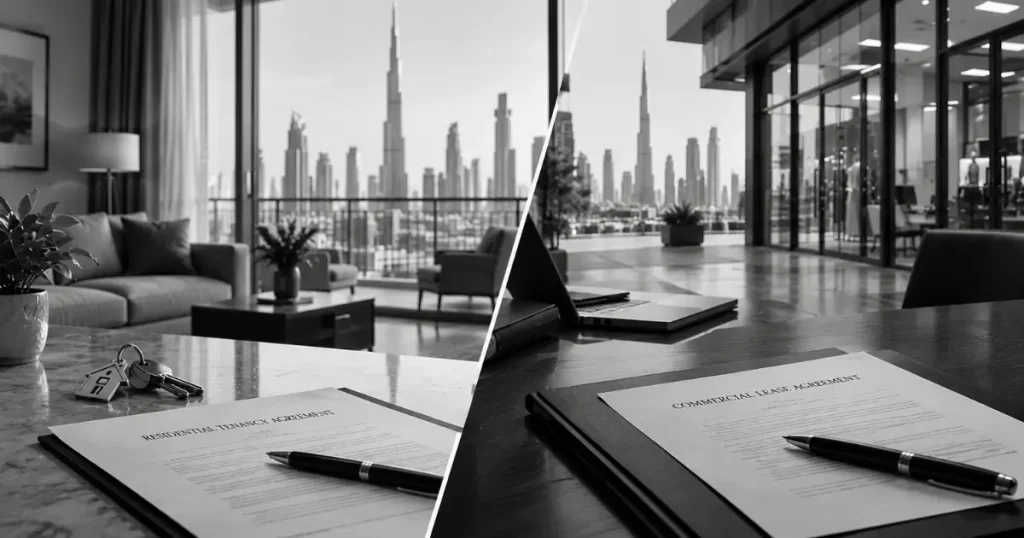
Understanding commercial vs residential tenancy laws in Dubai is important for landlords, tenants, investors and business owners before signing, renewing or terminating a lease.
Although both residential and commercial leases operate within Dubai’s tenancy framework, the practical issues can differ significantly. A residential apartment or villa involves different considerations from an office, retail shop, warehouse, showroom or other commercial premises.
The distinction matters when dealing with rent, renewal, eviction, maintenance, security deposits, early termination, permitted use, contractual obligations and tenancy disputes.
This guide explains the key differences between commercial and residential tenancy arrangements in Dubai while highlighting areas where the tenancy contract and applicable law should be reviewed together.
For broader property-law guidance, visit our real estate lawyer in Dubai resources.
Table of Contents
Quick Answer: Commercial vs Residential Tenancy Laws in Dubai
The main difference in commercial vs residential tenancy laws in Dubai is not that one type of lease is governed by law while the other is governed only by contract.
Both residential and commercial leases are subject to applicable Dubai tenancy legislation. However, the specific terms of the lease, the purpose of the property, the type of tenancy and the legal issue involved can affect the rights and obligations of the parties.
Commercial leases often contain more detailed negotiated provisions covering permitted use, fit-out, maintenance, insurance, renewal, rent escalation, assignment, subleasing and termination.
Residential leases also contain contractual terms, but statutory tenancy protections continue to apply.
Rental disputes within the jurisdiction of the Rental Disputes Center (RDC) are handled through Dubai’s specialized rental-dispute system. The RDC states that it has jurisdiction over rental disputes between landlords and tenants involving real property situated in Dubai, including free zones, subject to its governing framework. Rental Disputes Center – About RDC
Legal Framework for Commercial and Residential Tenancies
The principal Dubai tenancy legislation includes:
- Law No. 26 of 2007, regulating the relationship between landlords and tenants
- Law No. 33 of 2008, which amended Law No. 26 of 2007
- Decree No. 26 of 2013, establishing the Rental Disputes Center
These laws form an important part of the legal framework for Dubai tenancy relationships.
The RDC also provides services for first-instance rental lawsuits, appeals, execution and other rental procedures. RDC First-Instance Rental Lawsuit Service
When comparing commercial vs residential tenancy laws in Dubai, the applicable legislation should therefore be considered together with the actual tenancy agreement and circumstances of the dispute.
1. Definition: Commercial vs Residential Tenancy
Residential Tenancy
A residential tenancy generally concerns premises used for living purposes, such as:
- Apartments
- Villas
- Residential units
- Other premises lawfully used as accommodation
The primary purpose is residential occupation.
Commercial Tenancy
A commercial tenancy generally concerns premises used for business or commercial purposes, such as:
- Offices
- Retail shops
- Showrooms
- Warehouses
- Restaurants
- Business premises
The permitted use of the premises is particularly important in commercial leases because the tenant’s business activity may depend on licensing, approvals, fit-out permissions and property-use restrictions.
This distinction is one of the starting points when assessing commercial vs residential tenancy laws in Dubai because the purpose of the lease can affect the contractual obligations and practical risks involved.
2. Contract Flexibility
One of the most important differences in commercial vs residential tenancy laws in Dubai concerns the role of the tenancy contract.
Residential Leases
Residential leases remain subject to Dubai’s tenancy legislation even when the contract contains detailed provisions.
The parties should distinguish between:
- Terms that are contractually negotiated
- Obligations imposed by applicable law
- Rights that cannot simply be removed by contractual wording
A residential tenancy agreement should not be drafted on the assumption that every contractual clause automatically overrides statutory requirements.
Commercial Leases
Commercial contracts often contain more detailed provisions concerning:
- Rent and payment dates
- Rent escalation
- Fit-out
- Maintenance
- Insurance
- Permitted use
- Assignment
- Subleasing
- Renewal
- Early termination
- Default
- Penalties
- Reinstatement of premises
This makes careful contract drafting particularly important for commercial tenants and landlords.
However, saying that “the commercial contract always prevails” would be inaccurate. Contractual freedom operates within the limits of applicable law and the jurisdiction of the RDC.
3. Rent Increase Rules
Rent is another important consideration in commercial vs residential tenancy laws in Dubai.
Residential Tenancies
Dubai Land Department guidance states that the landlord’s ability to increase rent is linked to applicable rental-increase rules and the Rental Increase Calculator.
DLD also states that either party seeking to amend contractual terms or reconsider the rent should generally notify the other party at least 90 days before the expiry of the tenancy contract, unless the parties agree otherwise. Dubai Land Department – Frequently Asked Questions
The applicable rental increase should therefore be checked rather than assuming that a landlord can impose any percentage at renewal.
Commercial Tenancies
Commercial leases require closer examination of the specific contract and applicable legal rules.
A commercial lease may contain provisions concerning:
- Annual rent increases
- Fixed escalation percentages
- Rent-free periods
- Turnover rent
- Renewal rent
- Incentives
- Service charges
The existence of a contractual escalation clause does not mean that every dispute is automatically decided in favor of the clause. The wording must be considered together with applicable law and the facts.
Therefore, a simple statement that residential rent is always regulated while commercial rent is always flexible does not fully describe commercial vs residential tenancy laws in Dubai.
4. Eviction Rules
Eviction is one area where landlords and tenants should avoid relying on generalizations.
Residential Eviction
Dubai tenancy law identifies specific grounds on which eviction may be requested, with conditions that must be satisfied.
Dubai Land Department states that there are 13 cases in which eviction may be requested under Article 25 of Law No. 26 of 2007, as amended by Law No. 33 of 2008. Dubai Land Department – Tenancy FAQs
For certain grounds, including personal use, the law provides specific notice requirements.
A 12-month notice should therefore not be described as the mandatory notice for every residential eviction scenario.
Commercial Eviction
Commercial tenancy disputes can also involve eviction for reasons such as:
- Non-payment
- Unauthorized subleasing
- Breach of contractual obligations
- Unlawful use
- Other statutory grounds
The RDC’s published FAQ identifies non-payment and unauthorized subleasing among circumstances in which eviction may be requested and also refers to specific rules concerning unoccupied commercial premises. RDC – Frequently Asked Questions
The precise legal ground and contractual terms should be reviewed before serving an eviction notice.
The practical difference in commercial vs residential tenancy laws in Dubai is therefore not simply that commercial tenants can always be evicted more easily. The legal ground, contract, notice and evidence all matter.
5. Early Termination
Residential Tenancy
A tenant does not automatically acquire a general right to terminate a fixed-term tenancy early simply because they want to leave.
The contract, applicable law and circumstances should be reviewed.
Potential issues can include:
- Early termination clauses
- Notice
- Compensation
- Outstanding rent
- Mutual termination
- Breach by either party
Commercial Tenancy
Early termination can become particularly significant for businesses.
Commercial contracts may contain provisions covering:
- Break clauses
- Termination for convenience
- Termination for breach
- Notice periods
- Early-exit payments
- Reinstatement obligations
- Outstanding rent
- Security deposits
- Bank guarantees
A business should therefore understand its exit obligations before signing a long-term commercial lease.
This is an important contractual distinction when assessing commercial vs residential tenancy laws in Dubai, particularly for businesses committing significant capital to premises.
6. Maintenance and Repair Obligations
Maintenance is another area where the wording of the contract matters.
Residential Tenancies
Landlord and tenant responsibilities should be determined from the tenancy agreement together with applicable law.
Dubai Land Department guidance states that, unless otherwise agreed, the landlord is generally responsible for maintenance and repair of defects or damage affecting the tenant’s intended use of the property. Dubai Land Department – Frequently Asked Questions
Tenants should therefore check the contract before assuming that every repair is automatically the landlord’s responsibility.
Commercial Tenancies
Commercial leases can contain more detailed allocations of responsibility.
The contract may address:
- Structural repairs
- Internal repairs
- Air-conditioning
- Electrical systems
- Plumbing
- Common areas
- Fit-out
- Equipment
- Building systems
- Routine maintenance
A commercial tenant should understand these obligations before signing because maintenance responsibilities can materially affect operating costs.
Maintenance is therefore a significant issue when comparing commercial vs residential tenancy laws in Dubai, particularly where a commercial tenant occupies a large or specialized premises.
7. Security Deposits and Guarantees
Security arrangements can differ substantially between residential and commercial leases.
Residential
Residential leases commonly involve a security deposit.
The parties should document:
- Amount paid
- Payment date
- Property condition
- Inventory where relevant
- Permitted deductions
- Return procedure
Disagreements over deductions can become rental disputes if the parties cannot resolve them.
Commercial
Commercial arrangements may involve more extensive security mechanisms, depending on the transaction, including:
- Security deposits
- Bank guarantees
- Corporate guarantees
- Personal guarantees
- Post-dated cheques
- Other agreed security arrangements
The precise obligations depend on the contract and applicable law.
The difference in financial security is an important consideration in commercial vs residential tenancy laws in Dubai, especially where a commercial lease involves substantial rent or business investment.
8. Ejari and Tenancy Registration
Ejari is an important part of documenting tenancy relationships in Dubai.
However, it is too broad to state that the absence of Ejari automatically means that rent increases, eviction claims or all RDC proceedings will fail.
The RDC’s current FAQ expressly states that a rental claim can be registered without a rental contract in certain circumstances if a request to prove the leasehold relationship is included. RDC – Frequently Asked Questions
At the same time, the RDC’s first-instance rental service lists a copy of the latest lease/Ejari among the required documents for its standard filing process. RDC First-Instance Rental Lawsuit Service
For both residential and commercial tenants, maintaining accurate tenancy records is therefore important.
When assessing commercial vs residential tenancy laws in Dubai, Ejari should be treated as an important registration and evidentiary issue rather than as an automatic test that determines whether every legal claim succeeds.
9. Dispute Resolution at the RDC
Both residential and commercial tenancy disputes may fall within the jurisdiction of the Rental Disputes Center, depending on the nature of the dispute and the property.
The RDC describes itself as a specialized judicial system for rental disputes and states that its jurisdiction covers rental disputes between landlords and tenants concerning real property situated in Dubai, including free zones, subject to its governing framework. Rental Disputes Center – About RDC
The RDC provides services including:
- Amicable settlement
- First-instance rental lawsuits
- Appeals
- Execution proceedings
- Payment writs
- Offer and Deposit procedures
- Other rental-related applications
The RDC also provides electronic filing and tele-litigation services. RDC – Frequently Asked Questions
The dispute-resolution framework is therefore a key common feature of commercial vs residential tenancy laws in Dubai, even though the underlying contractual issues may differ.
10. Commercial vs Residential Tenancy Laws in Dubai: Key Risks Compared
| Area | Residential Tenancy | Commercial Tenancy |
|---|---|---|
| Primary use | Living/accommodation | Business/commercial activity |
| Contract importance | Important | Often highly detailed |
| Rent provisions | Subject to applicable rules | Contract and applicable law must be reviewed |
| Eviction | Statutory grounds and procedures apply | Contractual and statutory requirements may both matter |
| Maintenance | Contract and applicable law | Often specifically allocated in contract |
| Security | Usually deposit | Deposit, guarantees or other security may be negotiated |
| Fit-out | Usually limited | Often a major contractual issue |
| Permitted use | Residential use | Business activity and licensing can be critical |
| Financial exposure | Depends on lease | Can be substantial for businesses |
| Dispute forum | RDC where within jurisdiction | RDC where within jurisdiction |
This comparison shows why commercial vs residential tenancy laws in Dubai should not be reduced to the simple idea that residential tenants are protected while commercial tenants depend entirely on contracts.
Common Mistakes in Commercial and Residential Leases
Understanding commercial vs residential tenancy laws in Dubai is not enough by itself. The actual lease should also be reviewed carefully.
Using the Wrong Contract
A commercial lease should not simply use a residential tenancy template with the property description changed.
Commercial leases can require additional provisions covering:
- Business use
- Fit-out
- Signage
- Licensing
- Insurance
- Service charges
- Maintenance
- Assignment
- Subleasing
- Renewal
- Termination
Ignoring the Permitted Use
A tenant should confirm that the intended activity is permitted at the property and that the required approvals and licences can be obtained.
Assuming Every Rent Increase Is Valid
A rent increase should be assessed against the applicable rules rather than accepted or rejected solely on the percentage proposed.
Assuming Every Eviction Requires 12 Months’ Notice
The required notice depends on the legal ground for eviction.
Failing to Document Repairs
Photographs, invoices, inspection reports, emails and messages can become important evidence in a tenancy dispute.
The RDC confirms that modern communications such as WhatsApp messages and email can be relied upon as evidence in rental disputes when the applicable evidentiary requirements are satisfied. RDC – Frequently Asked Questions
Signing Without Reviewing the Exit Clause
Commercial tenants in particular should understand their financial obligations if the business closes, relocates or becomes unable to continue operating from the premises.
Practical Guidance for Residential Landlords and Tenants
When dealing with commercial vs residential tenancy laws in Dubai, residential parties should pay particular attention to:
- Correct tenancy documentation
- Ejari records
- Rent and payment evidence
- Rental increase rules
- Required notices
- Maintenance obligations
- Security deposits
- Eviction grounds
- Property handover evidence
Dubai Land Department’s official guidance should be checked for current rental-increase and tenancy requirements. Dubai Land Department – Frequently Asked Questions
Practical Guidance for Commercial Landlords and Tenants
Commercial parties should review:
- Permitted business use
- Lease duration
- Renewal rights
- Rent escalation
- Fit-out obligations
- Maintenance
- Insurance
- Service charges
- Assignment
- Subleasing
- Default provisions
- Early termination
- Guarantees
- Handover and reinstatement
For a substantial commercial lease, legal review before signing can help identify contractual risks that may become expensive to resolve later.
This is particularly important because commercial vs residential tenancy laws in Dubai can involve very different financial consequences even when the underlying tenancy framework is similar.
What Evidence Should You Keep?
Whether the property is residential or commercial, maintain a complete tenancy file containing:
- Signed lease
- Ejari documentation
- Payment records
- Cheques
- Bank transfers
- Notices
- Emails
- WhatsApp messages
- Photographs
- Inspection reports
- Maintenance requests
- Invoices
- Property handover records
- Correspondence with the landlord or tenant
Organized evidence can be particularly important if the dispute eventually reaches the RDC.
FAQs: Commercial vs Residential Tenancy Laws in Dubai
Are commercial and residential tenancy laws the same in Dubai?
Both are subject to Dubai’s tenancy framework, but the practical legal issues can differ depending on the property, purpose of the lease, contract terms and dispute involved.
Is a commercial lease more flexible than a residential lease?
Commercial leases often contain more extensively negotiated contractual provisions, particularly regarding business use, fit-out, maintenance, renewal and termination. However, contractual freedom remains subject to applicable law.
Does the Rental Increase Calculator apply to commercial properties?
The applicable rent-increase rules should be checked for the specific tenancy. DLD’s published guidance addresses rental increases and the Rental Increase Calculator, while the exact legal position can depend on the tenancy and circumstances. Dubai Land Department – Frequently Asked Questions
Is eviction easier for commercial tenants?
There is no single rule that makes every commercial eviction easier. The applicable statutory ground, contract, notices and evidence all matter.
Is Ejari required for commercial and residential leases?
Tenancy registration is important for both types of leases. However, the absence of an Ejari record does not automatically mean that every possible rental claim is rejected. The RDC confirms that a claim to prove the leasehold relationship may be registered in certain circumstances. RDC – Frequently Asked Questions
Where are commercial tenancy disputes resolved in Dubai?
Qualifying rental disputes fall within the jurisdiction of the Rental Disputes Center. The RDC states that its jurisdiction covers rental disputes between landlords and tenants concerning real property in Dubai, including free zones, subject to its governing framework. Rental Disputes Center – About RDC
Can WhatsApp messages be used in a Dubai tenancy dispute?
The RDC states that modern communication methods, including WhatsApp messages and email, can be admitted and relied upon as evidence in rental disputes when the applicable requirements are satisfied. RDC – Frequently Asked Questions
Should a lawyer review a commercial lease?
Legal review can be particularly useful where the lease involves substantial rent, a long term, fit-out costs, guarantees, complex termination provisions, business-specific obligations or significant financial exposure.
Final Thoughts
Understanding commercial vs residential tenancy laws in Dubai is important before signing, renewing or terminating a lease.
Residential and commercial tenancies operate within the same broader Dubai tenancy framework, but the legal and financial issues can differ significantly. Residential matters often involve rent, eviction, maintenance and statutory tenancy protections, while commercial leases may involve more extensive negotiations concerning business use, fit-out, escalation, guarantees, maintenance and termination.
The safest approach is not to assume that one set of rules applies identically to every lease.
Review the tenancy contract, identify the applicable legal requirements, keep documentary evidence and verify current procedures with the official authorities.
For official information, consult the Dubai Land Department and Rental Disputes Center.
If the lease involves significant financial exposure or complex contractual terms, consider obtaining advice from a qualified real estate lawyer in Dubai before signing or taking formal action.