

 By
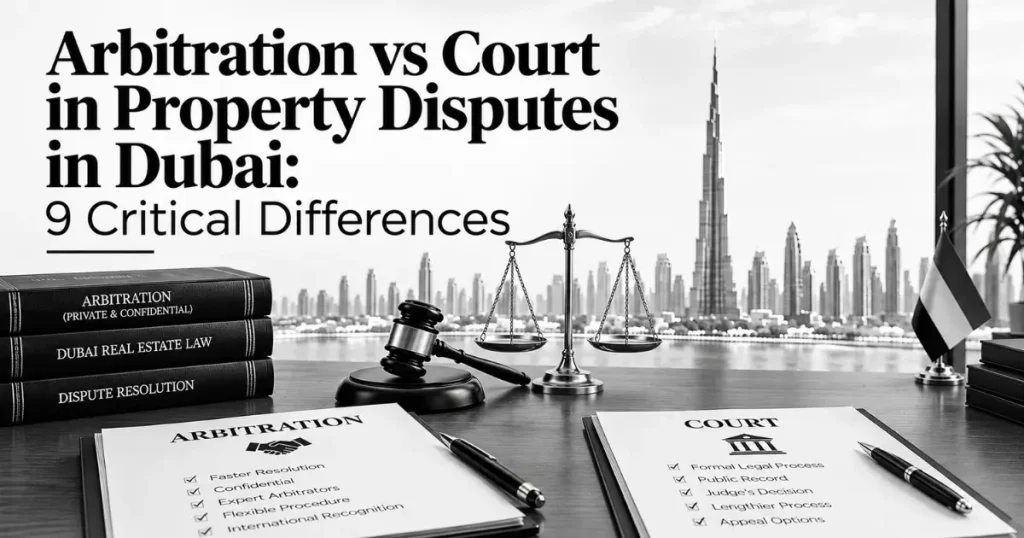
By Arbitration vs Court in Property Disputes in Dubai: 9 Critical Differences
When a property dispute arises in Dubai, one of the most important questions is where the dispute should be resolved. Depending on the contract, parties may face a choice between arbitration and court litigation, while some disputes may also involve regulatory or administrative processes.
Understanding arbitration vs court in property disputes in Dubai is particularly important before signing a sale and purchase agreement, development agreement, construction contract, property management agreement, investment agreement or other real estate contract.
The right forum depends on the arbitration agreement, contract wording, type of dispute, parties involved, applicable law, available remedies and enforcement requirements. There is no universal rule that arbitration or court litigation is automatically appropriate for every property dispute.
For background on the different types of property conflicts, see our guide to property disputes in Dubai.
Table of Contents
Quick answer: arbitration vs court in property disputes in Dubai
Arbitration is a private dispute-resolution process in which the parties submit an arbitrable dispute to one or more arbitrators under an arbitration agreement. Court litigation is determined by the competent judicial authority under applicable procedural and substantive law.
The most important differences generally concern:
- whether a valid arbitration agreement exists;
- jurisdiction;
- the identity of the decision-maker;
- procedural flexibility;
- confidentiality;
- costs;
- evidence and expert involvement;
- available challenges or appeals;
- enforcement of the final decision.
For arbitration vs court in property disputes in Dubai, the contract should be reviewed before assuming that either forum is available. Under UAE Federal Law No. 6 of 2018 concerning arbitration, a court can dismiss an action concerning a dispute covered by a valid arbitration agreement when the respondent makes the required request at the appropriate procedural stage, unless the agreement is void or unenforceable.
You can review the UAE Federal Arbitration Law before assessing the dispute-resolution clause.
1. Arbitration vs court in property disputes in Dubai starts with the contract
The first question is usually not which forum appears more convenient. It is whether the parties actually agreed to arbitration.
A property contract may contain an arbitration clause stating that disputes arising from or connected with the agreement will be referred to arbitration. The clause may also identify an institution such as the Dubai International Arbitration Centre (DIAC), specify the seat of arbitration, identify the governing law and establish procedural details.
For arbitration vs court in property disputes in Dubai, these contractual details can materially affect the available procedure.
A lawyer should therefore review the entire dispute-resolution clause rather than relying only on the heading or a general reference to arbitration.
What should be checked in an arbitration clause?
Important points include:
- Whether the clause is written clearly enough to establish an agreement to arbitrate.
- Which disputes are covered.
- Whether the clause identifies an arbitration institution.
- Whether DIAC or another institution is named.
- What seat of arbitration has been selected.
- Which substantive law governs the contract.
- How arbitrators are appointed.
- Whether there are pre-arbitration negotiation or mediation requirements.
- Whether there are contractual notice requirements.
- Whether the dispute is legally capable of being resolved through arbitration.
A poorly drafted clause can create unnecessary jurisdictional arguments before the substantive property dispute is even considered.
2. What is arbitration in a Dubai property dispute?
Arbitration is a private adjudicative process based on an agreement between the parties.
Instead of submitting the dispute to a court judge, the parties submit the dispute to an arbitral tribunal constituted according to their agreement and the applicable arbitration law and rules.
The tribunal considers the parties’ evidence and arguments and ultimately issues an arbitral award.
In Dubai, parties may agree to institutional arbitration under DIAC rules. The current DIAC Arbitration Rules 2022 came into effect on 21 March 2022 and operate alongside the UAE Arbitration Law.
This makes the arbitration vs court in property disputes in Dubai analysis particularly important for substantial commercial property transactions where the contract contains an institutional arbitration clause.
3. What does court litigation involve?
Court litigation involves submitting a claim to the competent judicial authority and following the applicable procedural rules.
Depending on the dispute and the parties involved, jurisdiction can be affected by the nature of the claim, contractual arrangements, property location, applicable legislation and other procedural considerations.
Court proceedings can involve:
- filing a claim;
- service of proceedings;
- written submissions;
- documentary evidence;
- expert reports;
- hearings;
- judgments;
- appeals where legally available;
- enforcement proceedings.
The court process is different from arbitration because the parties are not simply selecting a private tribunal under their contract.
When considering arbitration vs court in property disputes in Dubai, the specific jurisdictional facts should therefore be established before proceedings are commenced.
4. Arbitration vs court in property disputes in Dubai: jurisdiction
Jurisdiction is one of the most important issues.
If a valid and enforceable arbitration agreement covers the dispute, UAE Federal Law No. 6 of 2018 provides circumstances in which the court must dismiss an action concerning that dispute when the respondent properly requests dismissal before making a motion or plea on the merits, subject to the statutory exceptions.
This means a party should not assume that filing a court claim automatically overrides an arbitration clause.
At the same time, the existence of an arbitration clause does not mean every issue connected to a property transaction automatically belongs in arbitration. The wording of the clause, the nature of the claim and applicable law must be examined.
This is why arbitration vs court in property disputes in Dubai should be determined through a contract and jurisdiction review before filing.
5. Cost: arbitration is not automatically cheaper
Cost is often misunderstood when comparing arbitration and court proceedings.
Some parties assume arbitration is always faster and less expensive. That is not necessarily the case.
Arbitration can involve:
- institutional registration fees;
- administrative fees;
- arbitrator fees;
- tribunal expenses;
- legal fees;
- expert fees;
- document production;
- hearing-related costs;
- translation and interpretation expenses.
The overall cost depends heavily on the value and complexity of the dispute.
Court proceedings also involve court fees, legal fees, expert costs and other litigation expenses.
Therefore, for arbitration vs court in property disputes in Dubai, cost should be assessed based on the particular dispute rather than relying on a general assumption that one forum is always cheaper.
Questions to ask before choosing a forum
Consider:
- What is the value of the property claim?
- How many parties are involved?
- Will technical experts be required?
- Are there multiple contracts?
- Are documents located in different jurisdictions?
- Is a foreign party involved?
- Will translation be necessary?
- Is an urgent remedy required?
- Is enforcement likely to be contested?
These factors can materially affect the final cost.
6. Speed and procedural flexibility
Arbitration can offer procedural flexibility because parties may have greater scope to agree on procedural matters within the limits of the applicable law and institutional rules.
DIAC’s current rules are designed to provide procedural mechanisms for arbitration and include provisions intended to support efficient case administration.
However, arbitration is not automatically fast.
Complex property disputes can involve:
- extensive contracts;
- payment records;
- technical reports;
- construction evidence;
- valuation evidence;
- correspondence;
- multiple witnesses;
- expert examinations.
Court proceedings can also become lengthy when a case involves multiple procedural stages or appeals.
For arbitration vs court in property disputes in Dubai, the realistic timeline should therefore be estimated from the actual dispute rather than advertised as a guaranteed result.
7. Confidentiality and privacy
Confidentiality can be an important consideration in commercial property disputes.
Arbitration is commonly selected by businesses that want a private dispute-resolution process, subject to the applicable arbitration agreement, institutional rules, procedural orders and legal requirements.
This can matter where the dispute involves:
- commercially sensitive contracts;
- investment structures;
- financial information;
- development arrangements;
- proprietary business information;
- confidential negotiations.
Court litigation operates within the judicial system and its applicable procedural framework.
Consequently, confidentiality can be an important factor in arbitration vs court in property disputes in Dubai, but the exact level of confidentiality should be confirmed from the applicable agreement, rules and law rather than assumed.
8. Arbitrator versus judge
Another major difference concerns the person deciding the dispute.
In court litigation, the dispute is decided by the competent judicial authority.
In arbitration, the dispute is decided by an arbitral tribunal constituted according to the arbitration agreement and applicable rules.
Under the UAE Arbitration Law, the tribunal can consist of one or more arbitrators according to the parties’ agreement, subject to the statutory requirements.
For technically complex property disputes, the parties may consider the tribunal’s experience and the technical nature of the dispute when drafting or evaluating an arbitration clause.
However, the suitability of arbitration vs court in property disputes in Dubai depends on the complete dispute rather than simply the professional background of the decision-maker.
9. Appeals and challenges are different
A court judgment and an arbitral award are not challenged through identical procedures.
Court judgments may be subject to appeal or other forms of review where the applicable procedural law permits.
Arbitral awards are subject to the specific challenge and annulment framework established by UAE arbitration law. Arbitration should not be treated as simply another level of court litigation.
This distinction is important when assessing arbitration vs court in property disputes in Dubai because a party should understand the available post-decision remedies before agreeing to arbitration.
A lawyer should review:
- the applicable arbitration law;
- the arbitration agreement;
- institutional rules;
- the seat of arbitration;
- statutory challenge periods;
- enforcement requirements.
Arbitration vs court in property disputes in Dubai: comparison table
| Issue | Arbitration | Court litigation |
|---|---|---|
| Basis | Arbitration agreement generally required | Jurisdiction arises under applicable law |
| Decision-maker | Arbitrator or arbitral tribunal | Judge/court |
| Procedure | Governed by applicable law, agreement and rules | Governed by judicial procedural rules |
| Confidentiality | Can provide a private process, subject to applicable rules and law | Governed by court procedures |
| Cost | Institutional and tribunal costs may apply | Court and litigation costs apply |
| Flexibility | Generally greater procedural flexibility | More structured judicial procedure |
| Evidence | Parties present evidence under applicable rules | Evidence presented under court procedure |
| Appeals | Limited statutory challenge/annulment framework | Appeals may be available where permitted |
| Enforcement | Award requires the applicable recognition/enforcement process | Judgment enforced through judicial execution procedures |
| Contractual role | Depends heavily on arbitration agreement | Court jurisdiction depends on applicable law and procedure |
The table should be treated as a general comparison. The actual position can change depending on the contract, parties, property, dispute and applicable law.
Enforcement is a critical part of arbitration vs court in property disputes in Dubai
Obtaining a decision is only one part of dispute resolution.
The practical question is often whether the successful party can enforce the decision against the losing party or relevant assets.
Under UAE Federal Law No. 6 of 2018, enforcement of an arbitral award follows a statutory procedure requiring the relevant application and supporting documents. The law sets out requirements concerning confirmation and enforcement of arbitral awards.
A party should therefore assess enforcement at the beginning of the dispute rather than waiting until after an award is issued.
For arbitration vs court in property disputes in Dubai, enforcement planning is particularly important where:
- the respondent owns property;
- assets are located in different jurisdictions;
- a developer is involved;
- a corporate structure is involved;
- a foreign investor is involved;
- the dispute concerns significant sums.
Can a foreign arbitral award be enforced in Dubai?
Potentially, yes, but enforcement depends on the applicable legal framework and procedural requirements.
A foreign arbitral award may involve additional recognition and enforcement considerations compared with a domestic award.
The relevant issues can include:
- the seat of arbitration;
- applicable international conventions;
- UAE federal law;
- procedural requirements;
- validity of the arbitration agreement;
- proper notice;
- due process;
- public policy considerations;
- supporting documentation.
For a cross-border transaction, arbitration vs court in property disputes in Dubai should therefore include an enforcement analysis in every jurisdiction where assets may need to be reached.
What role does the Dubai Land Department play?
The Dubai Land Department (DLD) is highly relevant to real estate transactions, registration, project information and regulatory services.
However, parties should not assume that DLD acts as a general court for contractual property disputes.
DLD expressly states that it is not competent to adjudicate real estate disputes and contractual claims and that judicial authorities should be reviewed.
DLD also explains that certain complaints involving contractual disputes, contract revocation, refunds and indemnity claims are outside the jurisdiction of its real estate complaint service.
Therefore, arbitration vs court in property disputes in Dubai should not be confused with a routine DLD complaint.
DLD may have an important regulatory or administrative role while the actual contractual dispute may need to proceed through arbitration, the courts or another competent dispute-resolution mechanism.
What about RERA and property disputes?
The Real Estate Regulatory Agency (RERA) operates within Dubai’s real estate regulatory framework and has important regulatory functions.
However, a regulatory complaint and a contractual claim are not necessarily the same thing.
For example, a buyer may have concerns involving:
- a developer;
- an off-plan project;
- project registration;
- escrow arrangements;
- broker conduct;
- regulatory compliance.
The appropriate route depends on the precise issue.
A regulatory complaint should not automatically be treated as a substitute for a contractual claim, arbitration or court proceedings.
This distinction is particularly important in arbitration vs court in property disputes in Dubai because selecting the wrong procedure can create delays or jurisdictional problems.
Off-plan property disputes and arbitration
Off-plan disputes can be especially complicated because they may involve:
- sale and purchase agreements;
- escrow arrangements;
- project registration;
- Oqood or provisional registration;
- construction progress;
- payment schedules;
- handover obligations;
- cancellation;
- refunds;
- developer defaults.
Before commencing proceedings, review the SPA and all related documents.
Our guide to legal rights of off-plan property buyers explains additional protections and procedural considerations for off-plan transactions.
For arbitration vs court in property disputes in Dubai involving an off-plan project, the dispute-resolution clause should be read together with the applicable regulatory framework.
Property cancellation disputes
Project cancellation and buyer termination disputes require particular care.
A project being delayed, under cancellation review or formally cancelled does not necessarily produce the same legal consequences.
Dubai Land Department’s current FAQ explains that, in certain circumstances involving a project that has not started and is under cancellation, DLD does not itself have authority to terminate the developer-investor contract at the investor’s request; the investor may need to approach the competent real estate court, while DLD’s role can include reconciliation.
That distinction is important.
If the contract contains an arbitration clause, however, the contractual dispute-resolution mechanism also needs to be examined.
For arbitration vs court in property disputes in Dubai concerning cancellation, refund or termination, the correct forum cannot be determined solely from the fact that the dispute concerns a real estate project.
See our detailed guide to the legal process for project cancellation in Dubai.
Refund claims and contractual disputes
A buyer seeking a refund should first identify the legal basis of the claim.
Possible issues may include:
- contractual termination;
- developer default;
- project cancellation;
- misrepresentation;
- payment disputes;
- failure to perform contractual obligations;
- regulatory circumstances.
DLD’s published information specifically distinguishes contractual claims and refund-related matters from ordinary real estate violation complaints.
Accordingly, arbitration vs court in property disputes in Dubai should be analysed from the actual cause of action and the contract.
A refund request does not automatically establish that arbitration or court is the correct forum.
What evidence should property-dispute parties preserve?
Regardless of whether the case proceeds through arbitration or court, evidence can determine the strength of the claim.
Preserve:
Contracts
Keep the signed SPA, tenancy or commercial agreements, development agreements, amendments, addenda and side letters.
Payment evidence
Keep bank transfers, receipts, payment schedules, invoices and account statements.
Property records
Collect title deeds, initial registration documents, project records, NOCs and relevant DLD documents.
Communications
Preserve emails, letters, WhatsApp messages and other relevant communications.
Technical evidence
For construction or defect disputes, retain inspection reports, photographs, engineering reports and expert opinions.
Notices
Keep contractual notices, default notices, termination notices and responses.
Regulatory records
Retain relevant DLD, RERA, developer and project records.
For arbitration vs court in property disputes in Dubai, maintaining an organised evidence file before proceedings begin can significantly improve the ability to identify the real issues in dispute.
Common mistakes that can weaken a property dispute
1. Ignoring the arbitration clause
A party may begin court proceedings without first checking the dispute-resolution clause.
2. Assuming DLD decides every property dispute
DLD itself distinguishes regulatory complaints from contractual disputes.
3. Treating an arbitration clause as automatically valid for every issue
The wording and scope of the clause matter.
4. Assuming arbitration is always faster
Complex arbitration can still require extensive evidence and expert analysis.
5. Focusing only on winning the case
Enforcement should be considered from the beginning.
6. Missing contractual notice requirements
Some agreements require written notice before termination or proceedings.
7. Destroying or losing evidence
Digital correspondence and payment records can become critical evidence.
8. Relying on verbal promises
Important contractual variations should be documented appropriately.
9. Starting proceedings without identifying the correct parties
The correct developer, owner, company or contracting entity should be established before filing.
10. Using a generic legal strategy
A property purchase dispute, construction dispute and broker dispute may require very different approaches.
These mistakes show why arbitration vs court in property disputes in Dubai should be assessed on the actual facts rather than through a generic checklist.
When should a lawyer review the dispute-resolution clause?
Legal review is particularly useful before signing a high-value property agreement or immediately after a dispute emerges.
A lawyer can examine:
- arbitration wording;
- jurisdiction clauses;
- governing-law provisions;
- notice requirements;
- termination rights;
- payment provisions;
- default clauses;
- limitation issues;
- evidence;
- available remedies;
- enforcement considerations.
For a buyer considering a transaction, legal due diligence should ideally happen before signing rather than after a dispute arises.
See our property due diligence guide for Dubai for related checks.
How to assess arbitration vs court in property disputes in Dubai
There is no single answer for every dispute.
A practical assessment should consider these questions:
Question 1: Is there a valid arbitration agreement?
If not, arbitration may not be available simply because one party prefers it.
Question 2: What exactly does the clause cover?
A narrow clause may not cover every issue connected with the transaction.
Question 3: What relief is required?
Consider whether the claim concerns money, contractual performance, cancellation, registration, possession, property rights or another remedy.
Question 4: Where are the assets?
Enforcement may become a central issue if the respondent’s assets are outside the UAE.
Question 5: Are there multiple parties?
The ability to bind all relevant parties to one proceeding should be considered.
Question 6: Is expert evidence required?
Construction, valuation and technical disputes may require detailed expert evidence.
Question 7: Are there urgent issues?
Urgent applications and interim measures require careful procedural analysis.
Question 8: What does the contract say?
The contract is often the starting point for determining the agreed dispute-resolution mechanism.
Question 9: What is the likely enforcement route?
A decision that cannot practically be enforced may not achieve the client’s commercial objective.
For these reasons, arbitration vs court in property disputes in Dubai should be evaluated as part of a complete dispute strategy.
Arbitration vs court in property disputes in Dubai: a practical decision framework
Before commencing proceedings, prepare a short case assessment covering:
Contract:
Identify the arbitration clause, jurisdiction clause and governing law.
Claim:
Define exactly what the claimant wants to recover or achieve.
Evidence:
List the contracts, payments, notices, communications and technical records supporting the claim.
Parties:
Identify every relevant contractual and corporate entity.
Forum:
Determine whether arbitration, court litigation, regulatory action or another mechanism applies.
Costs:
Estimate legal, expert, institutional and procedural costs.
Timeline:
Identify realistic procedural stages rather than promising a fixed outcome.
Enforcement:
Determine where the respondent’s assets are located and how a decision may be enforced.
Risk:
Identify jurisdictional, contractual, evidentiary and limitation risks.
This framework makes the arbitration vs court in property disputes in Dubai analysis more practical for investors, owners, developers and businesses.
Frequently asked questions
Is arbitration mandatory for property disputes in Dubai?
No general rule makes arbitration mandatory for every property dispute. Whether arbitration applies depends on the relevant agreement and applicable law.
Can I go to court if my property contract contains an arbitration clause?
It depends on the clause, the dispute and applicable law. Under UAE Federal Law No. 6 of 2018, a court action involving a dispute covered by an arbitration agreement can be dismissed when the statutory requirements for invoking the arbitration agreement are satisfied.
Is arbitration cheaper than court in Dubai?
Not necessarily. Arbitration may involve institutional and arbitrator fees in addition to legal and expert costs. The economics depend on the dispute.
Is arbitration faster than court?
It can be procedurally flexible, but there is no universal guarantee that arbitration will be faster. Complex property disputes may require extensive evidence and expert analysis.
Is arbitration confidential?
Arbitration can provide a private dispute-resolution process, but the precise confidentiality obligations depend on the applicable agreement, rules and law.
Can an arbitral award be enforced in Dubai?
Yes, subject to the applicable UAE legal and procedural requirements for recognition and enforcement.
Does DLD decide contractual property disputes?
DLD states that it is not competent to adjudicate real estate disputes and contractual claims and directs parties to the relevant judicial authorities.
Does a DLD complaint replace arbitration?
Not necessarily. DLD distinguishes regulatory complaints from contractual claims, refunds and other disputes outside the relevant complaint service’s jurisdiction.
What if my off-plan project is cancelled?
The legal consequences depend on the project’s status, the applicable regulatory process, the SPA and the circumstances of the buyer’s claim. DLD’s FAQ explains that certain termination and refund situations may require recourse to the competent court.
Can a lawyer determine whether arbitration or court applies?
A lawyer can review the contract, dispute, applicable law, jurisdictional issues and requested remedies to identify the relevant dispute-resolution route.
What if the dispute involves a foreign investor?
Cross-border issues can make governing law, jurisdiction, arbitration seat and enforcement particularly important. The contractual structure should be reviewed before proceedings begin.
Can property disputes involve both regulatory and contractual issues?
Yes. A dispute may involve regulatory information or complaints alongside contractual claims. The appropriate route should be determined separately for each legal issue.
What should I do before filing a property dispute?
Collect the contracts, payment records, title or registration documents, correspondence, notices, technical reports and other supporting evidence. Then have the jurisdiction and dispute-resolution clause reviewed.
Documents to prepare before speaking with a property dispute lawyer
For a more efficient legal assessment, prepare:
- signed property contract or SPA;
- arbitration clause;
- amendments and addenda;
- payment receipts;
- bank statements;
- title deed or registration records;
- developer correspondence;
- broker correspondence;
- DLD or RERA records;
- notices;
- termination letters;
- technical reports;
- photographs;
- valuation reports;
- relevant emails and messages.
A complete document package allows the lawyer to analyse arbitration vs court in property disputes in Dubai more accurately and identify potential procedural issues early.
Official resources for Dubai property disputes and arbitration
For authoritative information, consult the following sources:
- UAE Federal Law No. 6 of 2018 Concerning Arbitration
- Dubai International Arbitration Centre — DIAC
- DIAC Arbitration Rules 2022
- Dubai Land Department
- DLD Contractual Dispute Information
- DLD Real Estate Complaints
- DLD Frequently Asked Questions
These sources should be checked alongside the actual contract and applicable legislation because general information cannot determine the correct forum for every individual dispute.
Final takeaway
Arbitration vs court in property disputes in Dubai is ultimately a question of contract, jurisdiction, dispute type, available remedies and enforcement strategy.
Arbitration can provide a private and potentially flexible mechanism where a valid arbitration agreement exists. Court litigation provides access to the judicial system and its statutory procedures and remedies. Neither mechanism should be treated as automatically suitable for every property dispute.
The most important step is to review the dispute-resolution clause before taking action. The parties should also identify the precise legal claim, preserve evidence, assess jurisdiction and consider how any eventual decision will be enforced.
For buyers, owners, developers and investors dealing with a significant property dispute, early legal review can help identify the correct forum before unnecessary proceedings or procedural mistakes occur.
If you need assistance assessing a property dispute, review our Dubai property dispute legal services or contact the legal team.
You can also visit the Real Estate Lawyer in Dubai homepage for related property-law resources and guides.