

 By
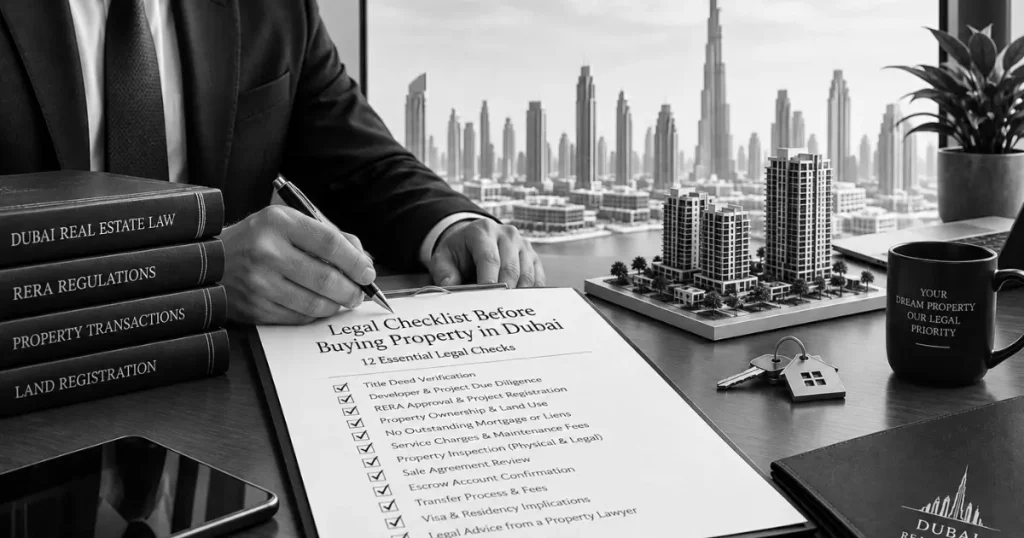
Legal Checklist Before Buying Property in Dubai: 12 Essential Legal Checks
Buying property in Dubai is a significant financial and legal commitment. Whether you are purchasing a completed apartment, villa, commercial property or an off-plan unit, the transaction involves more than agreeing on a price and signing a Sale and Purchase Agreement (SPA).
This legal checklist before buying property in Dubai is designed to help buyers identify the most important legal, ownership, contractual and registration issues before committing funds. It is particularly useful for first-time buyers, overseas investors and anyone purchasing property without fully understanding the Dubai real estate process.
The exact requirements can vary depending on the property, transaction structure, financing arrangements, ownership status and whether the property is completed or off-plan. Official Dubai Land Department (DLD) requirements should therefore be checked for the specific transaction.
Table of Contents
Quick Legal Checklist Before Buying Property in Dubai
Before signing or transferring a substantial amount of money, work through these 12 checks:
- Verify the seller’s ownership and title information.
- Check mortgages, restrictions and other registered interests.
- Verify the developer and project for an off-plan purchase.
- Review the SPA and every important contractual obligation.
- Confirm the property’s ownership or tenure structure.
- Check service charges, outstanding balances and community obligations.
- Verify the broker’s licence and authority.
- Review financing and mortgage requirements.
- Confirm the NOC and transfer requirements.
- Understand DLD registration and title-deed issuance.
- Calculate the full transaction and ownership costs.
- Obtain independent legal advice before making an irreversible commitment.
Completing these checks does not guarantee that a transaction will be risk-free, but it can substantially improve a buyer’s ability to identify problems before they become expensive disputes.
1. Verify the Seller’s Ownership and Title Deed
The first step in a legal checklist before buying property in Dubai is confirming that the person or entity selling the property has the legal authority to sell it.
Do not rely solely on a title-deed copy supplied by the seller, broker or another intermediary. The property’s ownership and transaction information should be independently verified through the appropriate DLD process.
Check:
- The registered owner’s name.
- The property or unit identification details.
- The title-deed information.
- Whether the seller is an individual, company or authorised representative.
- Whether a power of attorney is being used.
- Whether the property details match the property being marketed.
If a representative is acting for the owner, the authority to sell should also be examined. A buyer should not assume that possession of property documents or a broker’s representation proves legal authority to complete the sale.
For broader guidance on property-related legal issues, see our guide to real estate law in Dubai.
2. Check for Mortgages, Restrictions and Other Encumbrances
A property may be subject to a mortgage or other registered restriction. This is why checking the property’s legal status is an essential part of the legal checklist before buying property in Dubai.
If the seller has an outstanding mortgage, the transaction may require a coordinated redemption and transfer process rather than a simple transfer from seller to buyer.
DLD has a specific procedure for registering the sale of a mortgaged property. Its published process includes obtaining the relevant bank documentation and completing the mortgage-release requirements before the sale registration is finalised. See the official DLD procedure for registering the sale of a mortgaged property.
Before committing to the purchase, establish:
- Whether the property is mortgaged.
- The outstanding amount, if any.
- How the mortgage will be released.
- Which party is responsible for each payment.
- Whether the bank has issued the documents required for the transaction.
- Whether any other registered restriction affects the transfer.
Do not assume that an outstanding mortgage automatically makes a property impossible to buy. It may instead require a specific transaction structure and coordination between the buyer, seller, bank and registration authorities.
3. For Off-Plan Property, Verify the Developer and Project
If you are buying off-plan, the legal checks are different from those for a completed property. The buyer should investigate both the developer and the project before making substantial payments.
As part of your legal checklist before buying property in Dubai, verify:
- The developer’s relevant registration and licensing status.
- Whether the project is registered with the appropriate Dubai authorities.
- Whether the unit can legally be sold off-plan.
- The project’s registration and escrow arrangements.
- The proposed payment schedule.
- The contractual completion and handover provisions.
- The registration process for the buyer’s interest.
DLD’s project-registration service explains that project registration is connected with the opening of an escrow account for off-plan sales. Review the official DLD project registration requirements before proceeding with an off-plan purchase.
DLD also provides a specific service for registering initial sales of off-plan units. See DLD’s initial-sale registration service for the current process and required documents.
Buyers should be particularly cautious about requests to make payments through channels that do not match the project’s approved arrangements. Do not assume that an informal payment instruction from a salesperson is sufficient evidence that a payment is legally protected.
4. Review the Sale and Purchase Agreement Before Signing
The SPA is one of the most important documents in a property transaction. It should be reviewed before signing rather than after a dispute arises.
A thorough legal checklist before buying property in Dubai should include a clause-by-clause review of the agreement.
Pay particular attention to:
- Purchase price and payment schedule.
- Deposit and reservation arrangements.
- Completion or handover date.
- Conditions that must be satisfied before completion.
- Default provisions.
- Consequences of delayed payment.
- Consequences of delayed completion or handover.
- Termination rights.
- Refund provisions.
- Representations and warranties.
- Defect-related obligations.
- Service-charge responsibilities.
- Transfer and registration obligations.
- Dispute-resolution provisions.
Do not focus only on the headline purchase price. A contract can allocate substantial financial risk through payment deadlines, default clauses, completion conditions and termination provisions.
If you are unsure about a contractual clause, obtain legal advice before signing rather than assuming that it can easily be changed later.
5. Confirm the Property’s Ownership or Tenure Structure
Another essential part of the legal checklist before buying property in Dubai is understanding exactly what legal interest you are acquiring.
Depending on the property and transaction, the legal structure may involve freehold ownership, usufruct, musataha or another recognised property interest or long-term arrangement.
This distinction matters because the legal rights and obligations connected with an interest in property can differ. Buyers should understand the implications for:
- Resale.
- Leasing.
- Financing.
- Inheritance and succession planning.
- Transfer to another person or entity.
- Duration and nature of the legal interest.
Do not assume that every property marketed as an “ownership opportunity” provides exactly the same legal rights. The title and contractual documents should be examined carefully.
6. Check Service Charges and Outstanding Property Dues
Before purchasing an apartment or property within a managed development, investigate service charges and other amounts associated with the property.
Ask for current information concerning:
- Service charges.
- Outstanding balances.
- Maintenance obligations.
- Community or building rules.
- Any relevant notices affecting the property.
Do not simply accept a broker’s verbal statement that all amounts are paid. Obtain appropriate documentary confirmation and establish how any outstanding balance will be dealt with before completion.
This is particularly important because the financial position of a property can affect the practical ability to complete a transfer and the amount the buyer ultimately has to pay.
7. Verify the Real Estate Broker’s Licence and Authority
If a broker is involved, verify the intermediary rather than relying solely on a company logo, social-media profile or property advertisement.
A practical legal checklist before buying property in Dubai should include checking:
- The broker’s professional and licensing status.
- The brokerage company’s identity.
- Whether the broker is authorised to market the particular property.
- Who the broker represents.
- The agreed commission and who is responsible for paying it.
- Whether the broker’s statements are supported by documents.
DLD provides official real estate services and information that buyers can use when checking transaction-related matters. For official information, use the Dubai Land Department website rather than relying exclusively on information supplied by a third party.
A broker can facilitate a transaction, but a buyer should not assume that a broker’s role is the same as independent legal advice.
8. Review Mortgage and Financing Terms Before Committing
If you are financing the purchase, obtain clarity on the mortgage before signing an agreement that creates payment obligations.
Check:
- Mortgage approval conditions.
- Property valuation requirements.
- Interest or profit-rate structure, as applicable.
- Processing and other bank charges.
- Early settlement provisions.
- Mortgage registration requirements.
- What happens if financing is delayed or refused.
DLD’s mortgage-registration service currently states that mortgage registration involves specific documentation and a registration fee based on the mortgage value. Review the current DLD mortgage registration requirements.
Most importantly, understand whether your SPA gives you adequate contractual protection if your financing does not proceed as expected. Do not assume that a failed mortgage application automatically cancels your purchase without contractual consequences.
9. Confirm the NOC and Transfer Requirements
For many secondary-market transactions, the developer’s No Objection Certificate (NOC) forms part of the transfer process.
However, the exact requirement depends on the property and transaction. Therefore, rather than treating an NOC as a universal rule, confirm the current requirements applicable to the particular property.
DLD’s property sale registration service currently identifies an e-NOC from the developer as a required document for relevant sales in freehold areas. Review DLD’s current property sale registration requirements.
Before committing to completion, establish:
- Who will request the NOC.
- Who pays any applicable charges.
- Whether there are outstanding developer or property amounts.
- How long the NOC process is expected to take.
- Whether the NOC contains any conditions relevant to the transfer.
Because requirements can change, buyers should verify the current process rather than relying on an old checklist or informal advice.
10. Understand DLD Registration and Title-Deed Issuance
Signing a private contract is not the same thing as completing the official property-registration process.
As part of the legal checklist before buying property in Dubai, establish exactly how the transaction will be registered and what documents will be issued after completion.
DLD’s property sale registration service describes the registration process through Real Estate Registration Trustee centres and identifies the electronic title deed as an issued document. See the official DLD property sale registration process.
The transaction may involve:
- Identity and ownership verification.
- Submission of the required documents.
- Verification of transaction details.
- Payment of applicable registration and service fees.
- Completion of the transfer process.
- Issuance of the relevant registration output or electronic title deed.
Do not treat an informal side letter, receipt or private agreement as a substitute for the official registration process. If a document is being used to alter or supplement the commercial arrangement, have its legal effect reviewed before relying on it.
11. Calculate the Full Cost of Buying Property
The purchase price is only one part of the financial calculation.
A responsible legal checklist before buying property in Dubai should identify all material transaction costs before signing.
Depending on the transaction, these may include:
- DLD registration fees.
- Real Estate Registration Trustee service fees.
- Broker commission.
- Mortgage registration fees.
- Bank and valuation charges.
- Developer or NOC-related charges where applicable.
- Legal fees.
- Outstanding property-related amounts that must be settled before transfer.
DLD’s published property sale registration service currently lists the sale registration charge as 4% in total, with its service page specifying 2% for the seller and 2% for the buyer, subject to the transaction arrangements and applicable requirements. The same page lists additional title-deed, map and service-partner charges. Check the current DLD fees and requirements before budgeting for a purchase.
Because government fees and service charges can change, use the current DLD information applicable to your transaction instead of relying on an old article or calculator.
12. Obtain Independent Legal Advice Before the Final Commitment
The final and often most valuable step in a legal checklist before buying property in Dubai is obtaining independent legal advice before you become committed to the transaction.
A property lawyer can help assess issues such as:
- Ownership and title information.
- Contractual obligations.
- Developer and project documentation.
- Mortgage arrangements.
- NOC and transfer requirements.
- Payment and completion risks.
- Termination provisions.
- Potential disputes.
- Foreign-buyer documentation.
- Property-specific legal risks.
Legal advice is most useful before a buyer signs a binding agreement or transfers substantial funds. Once a dispute has arisen, the available options may be narrower and significantly more expensive.
If you are unsure whether professional assistance is necessary, our guide on when you need a property lawyer in Dubai explains situations in which legal advice can be particularly valuable.
Additional Checks for Foreign Buyers
Foreign buyers should add several additional questions to their legal checklist before buying property in Dubai.
Depending on the transaction, consider:
- Whether the property is in an area where the intended ownership structure is permitted.
- Whether a passport or other identification documents are sufficient for the transaction.
- Whether documents issued outside the UAE require attestation or other formalities.
- Whether a power of attorney is being used.
- How the purchase will be financed.
- Whether banking compliance requirements may affect the movement of funds.
- How ownership should be structured for succession and estate-planning purposes.
International buyers should also avoid assuming that a property purchase automatically resolves immigration, tax, succession or banking questions. Those issues may require separate professional advice depending on the buyer’s circumstances and country of residence.
Ready Property vs Off-Plan: Which Legal Checks Change?
A useful legal checklist before buying property in Dubai should distinguish between completed property and off-plan property.
| Legal issue | Completed property | Off-plan property |
|---|---|---|
| Seller/developer verification | Verify the registered owner and authority to sell | Verify the developer and project registration |
| Title or registration | Check title and transfer requirements | Check initial/provisional registration requirements |
| Mortgage | Check existing mortgage and release process | Check project financing and applicable mortgage arrangements |
| Contract | Review resale SPA and transfer terms | Review developer SPA, payment schedule and completion provisions |
| NOC | Confirm whether developer NOC is required | Check developer and project-specific requirements |
| Handover | Inspect existing condition and completion status | Review estimated completion, handover and contractual remedies |
| Escrow | Usually not the central issue in a completed-property resale | Verify the applicable project escrow arrangements |
The distinction matters because an off-plan purchase carries different risks from buying an already registered property. Buyers should not simply apply a secondary-market checklist to an off-plan transaction.
Red Flags to Investigate Before Buying Property in Dubai
Stop and obtain professional advice if you encounter any of the following:
- Pressure to transfer a large amount immediately without adequate documentation.
- Inconsistencies between the seller’s identity and property documents.
- Requests to make payments to an unrelated personal account.
- Unclear ownership or authority to sell.
- Unexplained differences between the advertised property and the legal documents.
- Unresolved mortgage issues.
- Unexplained outstanding charges.
- Requests to sign an SPA before you have had an opportunity to review it.
- Off-plan payment instructions that do not match the project’s approved arrangements.
- Promises that a contractual problem can simply be “fixed later.”
- Pressure not to obtain independent legal advice.
None of these circumstances automatically proves that a transaction is fraudulent or unlawful. They are warning signs that justify further verification before money or legal commitments are made.
Frequently Asked Questions About the Legal Checklist Before Buying Property in Dubai
What should I check before buying property in Dubai?
The main checks include ownership and title information, mortgages and restrictions, developer and project status for off-plan purchases, the SPA, ownership structure, service charges, broker authority, financing, NOC requirements, DLD registration and the full transaction costs.
Should I verify the title deed before buying a property in Dubai?
Yes. Buyers should independently verify the property’s ownership and registration information through the appropriate official process rather than relying solely on a document or screenshot supplied by a seller or intermediary.
Is a lawyer necessary when buying property in Dubai?
A lawyer is not required for every transaction, but independent legal advice can be valuable where the transaction involves substantial funds, unusual contractual terms, financing, off-plan property, a complex ownership structure, a foreign buyer, a mortgage, a power of attorney or potential legal risk.
What should I check when buying off-plan property in Dubai?
Check the developer, project registration, applicable escrow arrangements, initial registration process, SPA, payment schedule, completion provisions, cancellation and refund terms, and the legal process for registering your interest in the property.
What is an NOC in a Dubai property transaction?
A No Objection Certificate is a document that may be required from the developer or another relevant party for certain property transactions. The exact requirement depends on the property and transaction. DLD’s current sale-registration requirements should be checked for the specific purchase.
How much are Dubai property registration fees?
DLD’s current property sale registration service lists a total sale registration charge of 4%, specified on its service page as 2% for the seller and 2% for the buyer. The actual transaction may also involve additional fees and charges, so buyers should verify the current DLD requirements before calculating the total cost.
Can a foreigner buy property in Dubai?
Foreign ownership is permitted in designated areas and subject to the applicable Dubai property rules. The buyer should verify that the particular property and intended ownership structure are eligible before proceeding.
What happens if the property has an existing mortgage?
A property with an existing mortgage may still be sold, but the transaction requires the appropriate mortgage-release and registration procedures. The bank, seller, buyer and registration authorities may need to coordinate the process.
When should I hire a property lawyer?
The most useful time to involve a property lawyer is generally before signing a binding contract or transferring substantial funds. Early legal review allows potential contractual, ownership and transaction risks to be identified before they become disputes.
Official Dubai Land Department Resources
Because property procedures, fees and digital services can change, buyers should verify current requirements through official sources before completing a transaction.
- Dubai Land Department official website
- DLD Property Sale Registration
- DLD Register Project service
- DLD Initial Sale Registration
- DLD Sale of a Mortgaged Property
- DLD Mortgage Registration
Final Thoughts: Complete the Legal Checks Before You Commit
Buying property in Dubai can be a straightforward transaction when the buyer understands the legal process and verifies the important documents before committing money.
This legal checklist before buying property in Dubai should be treated as a practical starting point rather than a substitute for property-specific legal advice. The correct checks can differ depending on whether you are buying a completed property or off-plan unit, using finance, purchasing through a company, buying as a non-resident or dealing with a property that has an existing mortgage or other restriction.
The most important principle is simple: verify first, sign second and transfer substantial funds only after the legal and contractual position is clear.
If you are dealing with a property dispute, contract concern, developer issue, ownership question or another real estate matter, you can also review our property disputes in Dubai legal guide for further information.
For additional Dubai property-law resources and guidance, visit the Dubai real estate lawyer website and explore the relevant legal guides before making a major property decision.
2 Comments